Social and Economic Impact Assessment in Mongolia:
Introduction
Social and economic impact assessment is a structured research process used to identify, measure, and analyze the social and economic effects of projects, programs, policies, or investments. It focuses on understanding how an intervention affects people’s lives, economic activities, livelihoods, and overall well-being.
Unlike technical or financial evaluations, social and economic impact assessment looks beyond outputs and examines real-world changes experienced by individuals, households, communities, and institutions. As a result, it plays a crucial role in development planning, public policy, infrastructure projects, and private-sector investments.
SICA LLC
SICA LLC RESEARCH CONSULTING COMPANY
We analyze Mongolian and international market structure, supply and demand, competition, and consumer behavior to help you build a data-driven business strategy.
Social and economic impact assessment refers to the systematic analysis of both social outcomes and economic consequences resulting from an intervention.
Social impacts may include changes in:
Living standards
Access to services such as education and healthcare
By analyzing these dimensions together, social and economic impact assessment provides a holistic understanding of intervention outcomes.
Why Social and Economic Impact Assessment Matters
Decision-makers increasingly require evidence that projects and policies deliver measurable benefits rather than just meeting implementation targets.
Social and economic impact assessment helps:
Support evidence-based policy and investment decisions
Identify both positive and negative consequences
Improve accountability and transparency
Inform mitigation strategies and program redesign
Strengthen stakeholder trust and social acceptance
Without impact assessment, interventions risk overlooking unintended effects or failing to address real community needs.
Key Components of Social and Economic Impact Assessment
A comprehensive social and economic impact assessment typically includes the following components:
Baseline Analysis
Establishes pre-intervention social and economic conditions against which changes can be measured.
Impact Identification
Determines which social groups and economic sectors are likely to be affected and in what ways.
Measurement and Indicators
Uses qualitative and quantitative indicators to assess changes in social and economic outcomes.
Attribution and Contribution
Examines the extent to which observed changes can be attributed to the intervention.
Distributional Effects
Analyzes who benefits and who may be adversely affected.
Methodologies Used in Social and Economic Impact Assessment
Quantitative Methods
Household and business surveys
Employment and income analysis
Economic modeling and cost–benefit analysis
Analysis of administrative and statistical data
SICA LLC
SICA LLC RESEARCH CONSULTING COMPANY
We analyze Mongolian and international market structure, supply and demand, competition, and consumer behavior to help you build a data-driven business strategy.
Combining quantitative and qualitative methods allows for both statistical rigor and contextual understanding, strengthening the credibility of findings.
Applications Across Sectors
Social and economic impact assessment is applied across a wide range of sectors, including:
Infrastructure and construction
Mining and natural resources
Energy and environmental projects
Education and health programs
Social protection and employment initiatives
In each sector, the assessment helps ensure that economic benefits are balanced with social well-being.
Importance of Context in Impact Assessment
While global frameworks and standards guide social and economic impact assessment, local context is critical.
In Mongolia, assessments must consider:
Urban–rural disparities
Regional economic structures
Livelihood systems and labor markets
Institutional capacity and data availability
Context-sensitive assessment improves relevance, accuracy, and policy usefulness.
Challenges in Social and Economic Impact Assessment
Common challenges include:
Limited baseline data
Difficulty attributing impacts in complex environments
Time and budget constraints
Balancing stakeholder expectations
SICA LLC
SICA LLC RESEARCH CONSULTING COMPANY
We analyze Mongolian and international market structure, supply and demand, competition, and consumer behavior to help you build a data-driven business strategy.
Addressing these challenges requires strong methodological design and experienced research teams.
Conclusion
Social and economic impact assessment is a vital research tool for understanding how interventions affect people and economies in practice. By systematically measuring social and economic outcomes, it supports informed decision-making, responsible investment, and sustainable development.
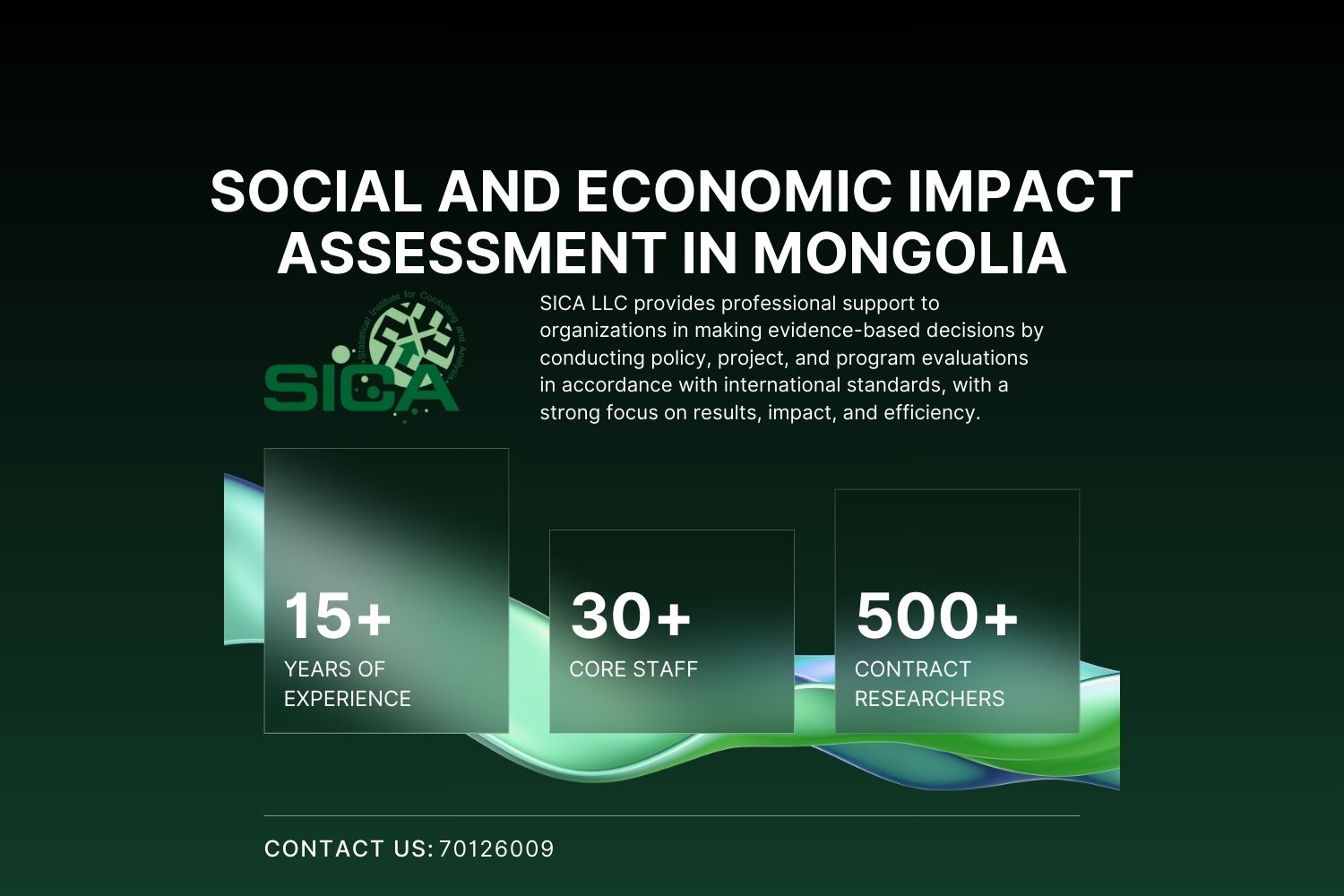
Organizations planning to conduct social and economic impact assessment can benefit from working with research teams that combine international standards with deep local knowledge. In this context, SICA LLC offers professional expertise in conducting social and economic impact assessments tailored to the Mongolian context.
.jpg)
.jpg)
.jpg)
.jpg)


